
Appetizing
Historic appetizing shops, smoked-fish counters, bialy bakeries, and Jewish food institutions across New York City.
A curated list.
And a suggest tasting crawl itinerary below.
Historic New York Appetizing Shops
New York’s historic appetizing shops are among the city’s most distinctive food traditions. Created by Jewish immigrants and shaped by generations of family businesses, these specialty stores offered the dairy, fish, and bread side of Jewish cooking: smoked salmon, lox, sable, sturgeon, whitefish, herring, cream cheese, bagels, bialys, babka, rugelach, pickles, salads, and sweets.
Unlike a traditional Jewish deli, which focused on meat dishes such as pastrami, corned beef, brisket, and chopped liver, an appetizing shop was built around foods that could be eaten together in a kosher home. A Sunday morning bagel with cream cheese and smoked fish is perhaps the most famous result of that tradition, but the world of appetizing is much broader, richer, and more personal than one sandwich.
At one time, hundreds of these shops served Jewish neighborhoods throughout New York City. Today, only a small number of historic survivors remain, mostly in Manhattan, along with several important places connected to the city’s smoked-fish, bagel, and Jewish bakery history. Visiting them is one of the best ways to taste old New York.
Historic survivors


Barney Greengrass
Established: 1908
541 Amsterdam Ave, Upper West Side, Manhattan
Instagram: @barneygreengrass
Barney Greengrass is widely considered the oldest surviving appetizing business in New York City. It originally opened in Harlem in 1908 and moved to its current Upper West Side location in 1929. It began as an appetizing store and later evolved into the sit-down Jewish restaurant, smoked-fish counter, and neighborhood institution it is today.
What to order: Sturgeon is the signature—hence its longtime nickname, “The Sturgeon King.” Also look for nova, sable, smoked whitefish, lox, scrambled eggs with smoked fish, latkes, bagels with cream cheese and fish, and traditional breakfast plates.
Why it matters: This is not a polished new Jewish restaurant trying to look historic. It is a genuine old New York survivor. The third generation of the Greengrass family has discussed how appetizing remains closely tied to Jewish holiday food and the Sunday-morning family breakfast ritual.

Zabar’s
Established: 1934
2245 Broadway, Upper West Side, Manhattan
Instagram: @zabars
Zabar’s opened in 1934, founded by Louis and Lillian Zabar. It began as a small Upper West Side specialty store and grew into one of New York’s most recognizable Jewish food markets. It is still a multigenerational Zabar family business.
What to order: Bagels, nova, lox, smoked salmon, sable, whitefish salad, smoked fish, cream cheese, coffee, rugelach, cheese, pickles, and Jewish pantry products. The coffee counter and smoked-fish counter are central to the experience.
Why it matters: Zabar’s is less narrowly “pure appetizing shop” than Russ & Daughters because it is also a broader gourmet grocery and food market. But it remains one of the definitive places to assemble an Upper West Side Jewish breakfast or Sunday brunch at home. It demonstrates how appetizing culture evolved from a specialized neighborhood food trade into a major New York retail institution.

Russ & Daughters
Established: 1914
179 E Houston St, Lower East Side, Manhattan
Instagram: @russanddaughters
Russ & Daughters is the city’s other indispensable historic appetizing store. It is widely described as the second-oldest surviving appetizing shop in New York City, after Barney Greengrass.
Joel Russ, a Jewish immigrant from Strzyżów, Poland, began by selling mushrooms and herring to Eastern European Jewish immigrants on the Lower East Side. He opened a storefront in 1914, moved to the current 179 East Houston Street address in 1920, and made his daughters full partners in the 1930s - renaming the business Russ & Daughters. The family’s current fourth generation continues to run the business.
What to order: A classic bagel with gaspe nova or smoked salmon, cream cheese, tomato, onion, and capers; sable; whitefish salad; pickled herring; smoked fish platters; babka; and rugelach.
Why it matters: Russ & Daughters is possibly the clearest remaining expression of the original New York appetizing-shop model: take a number, order fish by style and cut, add salads and dairy, choose bread, and carry home a full Sunday breakfast spread. It is as historically important to bagel culture as any dedicated bagel bakery.

Murray’s Sturgeon Shop
Established: 1945
2429 Broadway, Upper West Side,
Manhattan
Instagram: @murrayssturgeon
Murray’s Sturgeon Shop is a significant Upper West Side smoked-fish and appetizing survivor, founded in 1945 by Murray Bernstein; his brother Sam later became co-owner. The Bernstein brothers were born in Poland and immigrated to New York in the 1920s to escape antisemitism.
What to order: Sturgeon, caviar, smoked salmon, sable, whitefish, traditional prepared salads, gefilte fish, bagels, Jewish baked goods, and a wide range of specialty grocery items. The shop remains especially important for people who want smoked fish beyond the basic lox-and-cream-cheese order.
Why it matters: It is quieter and less tourist-saturated than Russ & Daughters, Zabar’s, or Barney Greengrass, which makes it one of the best off-the-beaten-path historic appetizing stops. It preserves the Upper West Side’s mid-century Jewish food geography, where smoked-fish specialists, bakeries, delis, and Jewish grocers once served a dense local community.
Kossar’s Bagels & Bialys
Established: 1936
367 Grand St, Lower East Side, Manhattan
Instagram: @kossars
Kossar’s is primarily a historic bialy bakery, not technically a classic appetizing shop. But it belongs on every appetizing route because its bagels, bialys, flagels, smoked fish, cream cheese, and Jewish bakery goods supply the bread side of the same food culture. Kossar’s opened in 1936 as Mirsky and Kossar’s Bakery and identifies itself as the oldest operating bialy bakery in the United States.
What to order: A warm onion bialy, poppy bialy, kettle-boiled bagel, large flat bagel or flagel, and smoked-fish topping or sandwich.
Why it matters: Kossar’s gives you the chance to taste bagel, bialy, and flagel side by side. It is the historic bakery counterpart to the appetizing shops that specialize in fish and dairy.

Modern heirs worth knowing
These are not historic survivors in the 1908–1945 sense, but they are high-value contemporary places extending the appetizing tradition:
Shelsky’s of Brooklyn
Established: 2011
141 Court St, Cobble Hill, Brooklyn
A Brooklyn smoked-fish specialist built in the tradition of old appetizing counters. Visit for carefully sourced smoked fish, bagels, cream cheese, salads, caviar, and excellent bagel sandwiches. It is one of the clearest younger-generation successors to the traditional appetizing model.
Frankel’s Delicatessen & Appetizing
Established: 2016
631 Manhattan Ave, Greenpoint, Brooklyn
A modern, chef-driven Jewish deli and appetizing shop in Greenpoint. It is more playful and contemporary than Russ & Daughters but deeply informed by bagel, smoked-fish, and Jewish deli culture. Order a smoked-fish-and-bagel sandwich or a pastrami-egg-and-cheese creation.
Baz Bagel and Restaurant
Established: 2015
181 Grand St, Williamsburg, Brooklyn
A colorful, modern Jewish-deli-and-bagel restaurant that brings appetizing foods into a social, all-day dining format. It is not historic, but it is useful for showing how bagel, bialy, smoked fish, latkes, egg creams, and deli flavors are being reinterpreted for newer audiences.
Historic fish connection
Acme Smoked Fish — Fish Friday
Established: Family fish business roots in the early 1900s; Acme smoking operation established in 1954
30 Gem St, Brooklyn, Greenpoint, Brooklyn
Instagram: @acmesmokedfish
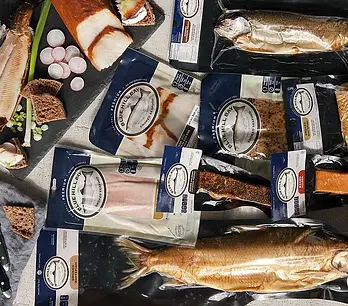
Acme is not a traditional corner appetizing shop, but it is one of the most important institutions behind New York’s smoked-fish culture. Its founder, Russian Jewish immigrant Harry Brownstein, came to Brooklyn in the early twentieth century and began distributing smoked fish to appetizing stores by horse-drawn wagon. The family established the Acme smoking operation in Greenpoint in 1954, and the company has remained family-owned through four generations.
What to do: Attend Fish Friday, when Acme opens its Greenpoint facility to the public for pickup and smoked fish sold at wholesale-style prices. It is one of the city’s best unusual food experiences for people interested in lox, whitefish, sable, herring, smoked salmon, and the actual supply chain behind New York bagel-and-fish culture. Current pickup is at 30 Gem Street on Fridays, generally from 8:00 a.m. to 1:00 p.m.; pre-ordering may be required.
Why it matters: Acme is the behind-the-scenes industrial history of appetizing. Russ & Daughters, Zabar’s, Barney Greengrass, and similar stores are where New Yorkers buy and eat smoked fish; Acme helps tell the story of how smoked fish was made, distributed, and kept central to the city’s Jewish food culture.

NYC Appetizing Crawl
Eat like a New Yorker.
Explore like a local. Pace yourself.
This is a full-day crawl through New York’s historic appetizing culture: smoked fish, sturgeon, herring, bagels, bialys, knishes, and the family-run institutions that made them part of the city’s food identity.
Start on the Upper West Side, where Jewish appetizing became part of everyday neighborhood life. Then take the subway downtown to the Lower East Side, the historic center of Eastern European Jewish immigration and bakery culture. Finish in Brooklyn, beginning in Greenpoint and ending in Cobble Hill.
Share, sample, take food to go, and save room for smoked fish, bialys, and a knish. The goal is to taste the range of New York appetizing, not to rush through it.
Stop 1: Zabar’s
2245 Broadway, Upper West Side, MANHATTAN
Start at Zabar’s, the essential Upper West Side Jewish food market.
What to try: Buy a small bagel with nova or smoked salmon, cream cheese, and perhaps a few rugelach for later. You are sampling here, not having a full breakfast.
Next: Walk north along Broadway and Amsterdam Avenue toward Barney Greengrass. It is about a 10 to 15 minute walk.
Stop 2: Barney Greengrass
Barney Greengrass
541 Amsterdam Ave, Upper West Side, Manhattan
Barney Greengrass is one of New York’s most historic appetizing institutions. It began in 1908 and is known as “The Sturgeon King.” This is a sit-down restaurant as well as a smoked-fish destination, so it is an ideal place to slow down and experience the classic old-school Upper West Side version of Jewish food.
What to try: Share an order of smoked sturgeon, nova, sable, or whitefish with bagels and cream cheese. If you are hungry, order eggs with smoked fish. If you are pacing yourself, make it a fish-and-coffee stop.
Next: Walk south along Amsterdam Avenue and Broadway toward Murray’s Sturgeon Shop. It is roughly a 10-minute walk.
Stop 3: Murray’s Sturgeon Shop
Murray’s Sturgeon Shop
2429 Broadway, Upper West Side, Manhattan
Murray’s Sturgeon Shop is a quieter, wonderfully old-school Upper West Side specialist. This is a proper smoked-fish and gourmet-food shop where you can browse sturgeon, caviar, smoked salmon, sable, whitefish, herring, prepared salads, gefilte fish, dried fruits, and Jewish pantry goods.
What to try: Pick up a small smoked-fish selection, caviar if you are splurging, or an item to take to your hotel for a later snack. This is the place to notice that appetizing is much more than lox.
Next: Take the subway downtown. Walk to the 79 St station at Broadway and take the 1 train downtown to the Houston St station. From there, walk east toward Kossar’s on Grand Street. Subway service can change, so check the MTA app or current service notices before leaving. The Upper West Side is served primarily by the 1, 2, and 3 trains along Broadway.
Stop 4: Kossar’s Bagels & Bialys
Kossar’s Bagels & Bialys
367 Grand St, Lower East Side, Manhattan
Kossar’s is the Lower East Side’s landmark bialy bakery and the oldest operating bialy bakery in the United States. Kossar’s also makes kettle-boiled bagels and large flat bagels called flagels.
What to try: Order one warm onion bialy and eat it plain first. Then compare it with a plain bagel or a flagel. If you are sharing, take a mixed bag of bialys, bagels, and flagels for the rest of the crawl.
Next: Walk west and slightly north to Russ & Daughters on East Houston Street. It is about a 10-minute walk.
Stop 5: Russ & DaughtersRuss & Daughters
179 E Houston St, Lower East Side, Manhattan
Russ & Daughters is the defining New York appetizing shop. Founded in 1914 by Polish Jewish immigrant Joel Russ, the business remains family-run and is the historic place to learn the language of smoked fish: nova, lox, gaspe, sable, sturgeon, whitefish, herring, caviar, and more.
What to try: Ask for a small bagel-and-smoked-fish order, or build a take-home appetizing box with smoked salmon, cream cheese, tomato, red onion, capers, and a bagel. If you want to go beyond lox, try sable or whitefish salad.
Next: Walk west along East Houston Street to Yonah Schimmel. It is only a few minutes away.
Stop 6: Yonah Schimmel Knish Bakery
Yonah Schimmel Knish Bakery
137 E Houston St, Lower East Side, Manhattan
Founded in 1910, Yonah Schimmel is one of the city’s great Jewish bakery survivors. It is not an appetizing shop in the strict fish-and-dairy sense, but no Lower East Side Jewish-food crawl is complete without a knish. The bakery is known for potato, kasha, spinach, sweet potato, mushroom, cabbage, cheese, and seasonal knishes.
What to try: Split one classic potato knish or kasha knish. If you are visiting with someone, order a savory knish and a sweet cheese or fruit variety to compare.
Next: Head to Brooklyn. The cleanest route is to take the F train from Delancey Street–Essex Street toward Brooklyn, then transfer or continue based on live service for Greenpoint. Because subway routes and weekend work change frequently, use the MTA app before leaving. Your first Brooklyn goal is Greenpoint.
Stop 7: Acme Smoked Fish
Acme Smoked Fish
30 Gem St, Greenpoint, Brooklyn
Acme Smoked Fish is the behind-the-scenes industrial heart of New York’s smoked-fish culture. Its family roots go back to the early twentieth century, and its Greenpoint smoking operation was established in 1954. This is not a traditional walk-in appetizing shop; it is a major smoked-fish producer that supplies the larger New York food world.
What to try: Plan this stop around Fish Friday, Acme’s direct public pickup program. Pre-order smoked salmon, lox, whitefish, trout, sable, dips, and other fish, then collect them from the factory. This is one of the city’s best insider food experiences. Pickup details and ordering windows can change, so confirm directly before planning the crawl.
Next: Travel deeper into Greenpoint for Frankel’s. Depending on timing and your appetite, this is a short ride or a longer walk. Consider a taxi, rideshare, or Citi Bike if you are carrying a Fish Friday order.
Stop 8: Frankel’s Delicatessen & Appetizing
Frankel’s Delicatessen & Appetizing
631 Manhattan Ave, Greenpoint, Brooklyn
Frankel’s is a modern Brooklyn interpretation of the classic Jewish deli and appetizing shop. Founded by brothers Alex and Zach Frankel, it brings smoked fish, bagels, whitefish salad, pastrami, egg-and-cheese sandwiches, matzo ball soup, and Jewish comfort food into a lively contemporary counter-service format.
What to try: If you still have room, split a smoked-fish bagel sandwich or a whitefish-salad bagel. If you are too full, take cookies, rugelach, or another small item for later. This is the place to see how a younger generation is reworking Jewish New York food without losing the appetizing vocabulary.
Next: Take the G train from Greenpoint toward Brooklyn, then connect to reach Cobble Hill. A practical option is the G to Hoyt–Schermerhorn, followed by a walk or a short local connection toward Court Street. Check current MTA directions in real time, particularly on weekends.
Stop 9: Shelsky’s of Brooklyn
Shelsky’s of Brooklyn
141 Court St, Cobble Hill, Brooklyn
End in Cobble Hill at Shelsky’s, a serious modern appetizing shop that opened in Brooklyn in 2011. It was created for people who wanted smoked salmon, pickled herring, whitefish, caviar, bagels, and old-school Jewish food without having to travel to the Lower East Side.
What to try: Finish with a small smoked-fish plate, pickled herring, a bagel with a spread you have not tried yet, or a take-home package for breakfast the next morning. If you have been sampling carefully all day, this is also the right place to buy a polished final souvenir: smoked fish, caviar, or a packaged gift item.
Pace yourselfThis crawl works best when two people share food. Buy small portions, split sandwiches, and ask for items to go. The Upper West Side gives you smoked fish and old-school appetizing. The Lower East Side gives you bialys, knishes, and immigrant Jewish food history. Greenpoint gives you the smoked-fish production story and a contemporary deli revival. Cobble Hill offers a final, beautifully curated appetizing counter.
The ideal crawl is not about eating nine full meals. It is about learning the difference between lox and nova, bagel and bialy, sturgeon and sable, a historic appetizing shop and a modern revival, and a Lower East Side Jewish bakery and Brooklyn’s living food culture.
Bete’avon - בתיאבון