
Nostalgia
My jewish food & history tour of the lower east side.
A curated itinerary.
The perfect self-guided one or two days on the lower east side. 19+ stops. Pace yourself. 2-3 Mile walk.
start here

1. Nine Orchard Hotel / Jarmulowsky Bank
This is one of my favorite hidden-history stops. Today's luxury Nine Orchard occupies the spectacular 1912 Jarmulowsky Bank Building, founded by Jewish immigrant banker Sender Jarmulowsky. Immigrant customers deposited savings here and bought steamship tickets to bring relatives to America.
LOOK UP: The restored rooftop tempietto and the name Jarmulowsky carved into the building. Starts with coffee and breakfast and enjoy the beauty.
BONUS: Peek into the restored former banking hall, now the Swan Room.

2. Michaeli Bakery
Michaeli Bakery — Your Israeli-bakery beginning. Founded by Israeli baker Adir Michaeli, who previously worked at Tel Aviv's Lehamim and was part of the opening team at Breads Bakery. The LES shop opened in 2019.
TRY: Babka, rugelach or bourekas.
2nd Location: 91st and 1st Avenue

3. Elbow Bread
The new Lower East Side interpreting the old Lower East Side. Zoë Kanan opened it in 2024, taking Jewish breads and pastries such as bialys, challah, rugelach and knishes and giving them a contemporary spin.
LOOK FOR: How traditional Jewish bakery foods have been reimagined rather than simply reproduced.

4. Museum at Eldridge Street
Museum at Eldridge Street occupies the magnificent 1887 Eldridge Street Synagogue, the first grand synagogue purpose-built in the U.S. by Eastern European Jewish immigrants.
LOOK FOR: The extraordinary stained glass and restored sanctuary. The contemporary east window by artist Kiki Smith and architect Deborah Gans is especially worth finding.
PACE YOURSELF: Exterior if you're doing the quick version; allow roughly an hour if you go inside.
.jpeg)
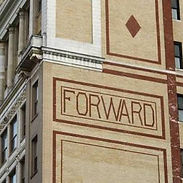
5. Forward Building
One of the great physical remnants of Yiddish New York: former headquarters of the Jewish Daily Forward.
LOOK UP: Don't just photograph the building. Look at the façade for the historic lettering and sculpted figures. The building and Jarmulowsky Bank were both completed in 1912 and represented two very different sides of immigrant Jewish life -the socialist newspaper and the capitalist bank.

6. Kehila Kedosha Janina
Kehila Kedosha Janina Synagogue and Museum tells a Jewish story many visitors don't know: the Romaniote Jews of Greece, rather than the neighborhood's better-known Eastern European Jewish history. It is the only Romaniote synagogue in the Western Hemisphere.
LOOK FOR: The modest 1927 façade at 280 Broome Street. If you can visit when the museum is open, its collection includes traditional objects and distinctive hand-painted Romaniote birth certificates called Alefs.
Kossar's
Kossar's Bagels & Bialys dates to 1936 and describes itself as the oldest operating bialy bakery in the United States. The bialy came to the Lower East Side with Jewish immigrants from Poland.
TRY: This should be the bialy stop, not another bagel stop. Onion bialy is the obvious classic.
PACE YOURSELF: Share one. There is a lot more food coming.

Pickle Guys
The Pickle Guys is the last remaining pickle store on Essex Street, once packed with pickle merchants. Their pickles are still barrel-cured in salt brine using an Eastern European-style tradition.
LOOK FOR: The barrels.
TRY: One classic sour pickle while you walk. Around Passover, they also continue the old neighborhood tradition of grinding fresh horseradish outside.
Moishe's
This is your old-school kosher bakery nostalgia stop.
LOOK FOR: The storefront and the feeling of a disappearing Lower East Side bakery tradition.
TRY:

BIALYSTOKER SYNAGOGUE
THIS is an unexpected NYC history stop. The congregation occupies an 1826 former Methodist church built of Manhattan schist. It became the synagogue in 1905.
LOOK FOR: The beautiful Federal-era exterior. Inside, a concealed opening in the women's gallery leads by ladder to an attic. Synagogue tradition holds that the former church sheltered people escaping slavery as part of the Underground Railroad. We should preserve that careful wording because the synagogue itself describes it as legend.

Essex Market
A break from individual historic businesses and a chance to see how the Lower East Side's market tradition continues today.
DO: Wander rather than treating this as another full meal. It is a good bathroom/rest/water stop in a 19-stop day.
Tenement Museum
The immigrant story behind everything you're eating. The museum interprets the lives of actual families who lived in Lower East Side tenements and now also offers food experiences exploring the neighborhood's immigrant cuisines.
PACE YOURSELF: You do not need to take a full tour as part of this itinerary. Make it optional: Quick stop outside / Deep dive: book a tour.

Blue Moon Hotel / Sweet Dreams Café
100 Orchard St
This should be one of your architecture + preservation moments rather than another eating assignment.
LOOK FOR: The historic tenement context and details you photographed when you walked the route.

Russ & Daughters Café
Russ & Daughters Cafe gives people the sit-down version of the Russ & Daughters experience. The family story began when Jewish immigrant Joel Russ sold herring from a pushcart; in 1933 he made his three daughters partners, creating what the Tenement Museum describes as the first known U.S. business with “and Daughters” in its name.
TRY:

Economy Candy
Economy Candy is the fun palate cleanser from all the serious history.
MISSION: Go inside and find something you remember from childhood.
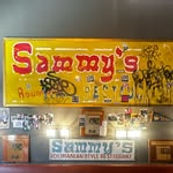
Sammy's
A nod to one of the Lower East Side's legendary Jewish dining institutions. Since this is an exterior/history stop on your route rather than the place we're sending them for a meal, keep this one short.
LOOK FOR: The location and imagine the old-school, exuberant Jewish restaurant culture that once filled places like Sammy's.

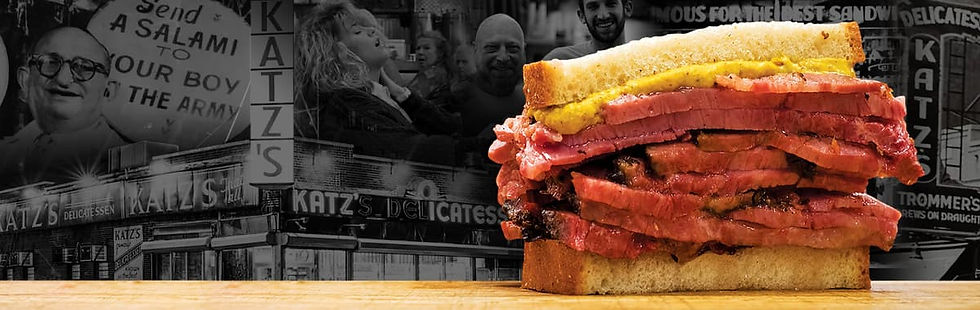
Katz's
LOOK FOR: The old ticket system, packed dining room and walls of photographs — the spectacle is part of the experience.
TRY: Obviously the famous order is pastrami,
Yonah Schimmel
Yonah Schimmel Knish Bakery is one of the essential edible-history stops on East Houston. The Tenement Museum itself categorizes it as a Jewish knish-and-kugel destination.
TRY: Potato knish

Russ & Daughters original
This is different from the café and absolutely worth keeping as its own stop. Joel Russ began with a pushcart in 1907, opened a shop in 1914, moved to East Houston in 1920, and renamed it Russ & Daughters in 1933 when his daughters became partners.
LOOK FOR: The counter itself. This is living New York food history, not a recreation.
TRY:
STILL HUNGRY? KEEP WALKING.
BONUS STOP 20
.webp)
20. B&H DAIRY - AN OLD NEW YORK SURVIVOR
127 Second Avenue
WHY GO: One of New York City's last remaining old-school kosher dairy lunch counters, serving the kind of Jewish comfort food that once filled this part of Manhattan.
LOOK FOR: The tiny old-fashioned counter, restored vintage-style storefront signage and wonderfully unpolished old-New-York atmosphere.
TRY: Challah, borscht, cheese blintzes, latkes or matzo brei. Their own site calls out the challah and soups as house specialties.
LOWER MANHATTAN: WHILE YOU'RE THERE, LOOK CLOSER...
If you have a little extra time downtown, there are pieces of Non-food Jewish New York hiding in plain sight around Lower Manhattan - very much worth visiting. Some are centuries old. Others tell powerful stories connected to the Holocaust, September 11 and a Jewish community that has been part of New York since the 1600s.
Here are four worth seeking out. A curated list.
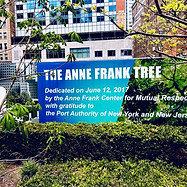
1. ANNE FRANK TREE
Liberty Park at the World Trade Center
Look for a white horse chestnut tree growing quietly in Liberty Park overlooking the World Trade Center.
This is not just any tree. It is a sapling descended from the famous chestnut tree Anne Frank could see from the Secret Annex in Amsterdam while she and her family were in hiding.
Anne wrote about the tree in her diary. Looking through the attic window at the chestnut tree, the sky and the birds gave her a precious connection to nature and the world outside.
The original tree eventually became seriously diseased and fell during a storm in 2010. But its story did not end there. Chestnuts had been collected and germinated, and saplings descended from Anne's tree have been planted at meaningful locations around the world.
New York's sapling was planted in Liberty Park in 2016 as one of 11 saplings donated to significant sites around the United States through the Anne Frank Center's Sapling Project.
WHEN YOU TRAVEL
Look for Anne Frank tree saplings in other cities, too. I do. When I find one, I leave flowers, something I have now done at Anne Frank trees in several cities around the world.
It has become one of the little things I look for when I travel.
LOOK FOR: The plaque identifying the Anne Frank Tree. Then look up through its branches and remember the tree Anne once looked toward from her attic window.
About the tree: www.annefrank.org/en/anne-frank/front-section/chestnut-tree/
.jpeg)
2. REMEMBER
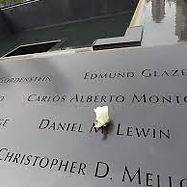
DANIEL M. LEWIN
9/11 Memorial, North Pool — Panel N-75
Among the thousands of names inscribed at the National September 11 Memorial, look for Daniel M. Lewin.
Lewin was a 31-year-old Israeli American technology entrepreneur and co-founder of Akamai Technologies. He was a passenger aboard American Airlines Flight 11, the first plane hijacked on September 11.
Lewin had previously served four years as an officer in the Israeli military. According to the 9/11 Commission, he was seated immediately behind hijackers Mohamed Atta and Abdulaziz al-Omari and immediately in front of another hijacker. The Commission concluded that Lewin may have attempted to stop the hijackers in front of him, unaware that another was sitting directly behind him.
He was stabbed and is considered the first person killed in the September 11 attacks.
His name is inscribed with the victims of Flight 11 around the North Pool at:
PANEL N-75
LOOK FOR: Daniel M. Lewin.
Stop for a moment. Find his name. Remember him.

3. WALL STREET SYNAGOGUE
47 Beekman Street
Despite its name, Wall Street Synagogue is on Beekman Street, a short walk from the World Trade Center.
The synagogue has its own powerful connection to September 11.
Six members of its congregation were killed in the attacks. The firehouse immediately next door lost four firefighters.
In the aftermath, the synagogue became part of the neighborhood's story of survival and recovery. Despite the devastation surrounding Lower Manhattan, the congregation was able to reopen and hold Rosh Hashanah services the week after the attacks.
LOOK FOR: Stand outside and look at the synagogue and its neighboring firehouse together. Their physical proximity makes the story of the two communities particularly moving.
It is a small New York story about faith, loss, resilience and neighbors.
4. ONE OF MANHATTAN'S OLDEST SURVIVING JEWISH CEMETERIES
FIRST HEARITH ISRAEL GRAVEYARD
55-57 St. James Place
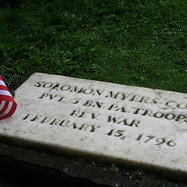
You could walk right past First Shearith Israel Graveyard, Chatham Square Cemetery without realizing that more than three centuries of Jewish New York are sitting behind the gate. The cemetery belongs to Congregation Shearith Israel, New York's first Jewish congregation, established by the city's early Sephardic Jewish community in 1654. The surviving Chatham Square Cemetery was purchased in 1682. It contains members of some of New York's earliest Jewish families, including the Seixas, Nathan, Levy and Phillips families. The cemetery was once considerably larger. As New York expanded, portions were lost to development. In 1855, expansion of the Bowery required 256 graves to be removed and reinterred elsewhere. LOOK THROUGH THE GATE: Access is limited, so this is primarily a look-from-outside stop. Look at the old stones sitting amid modern Lower Manhattan.


